Designing AI Deliberation at Google AI Campus
A live Pol.is workshop on AI and wealth inequality
The Brief
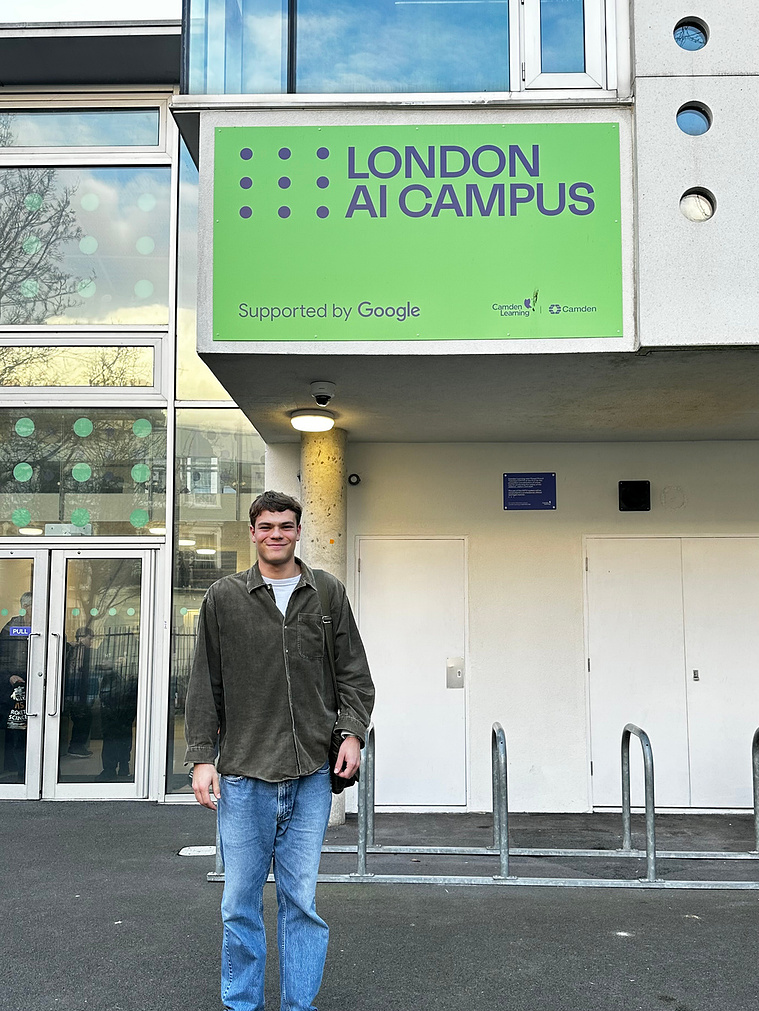
As a Research Fellow at Encode, I was asked to design a deliberative experience that would let a politically diverse audience surface their actual views on AI and wealth inequality, not just hear a panel talk about it. The goal: turn a room full of students into structured, clusterable signal in under an hour.
What I Did
I designed and ran the workshop end-to-end using Pol.is, an open-source platform for real-time opinion clustering. That meant writing the prompts, designing the session flow, running the room live and exporting the clustered data afterwards.
The hardest part wasn't the tool, it was the prompt engineering. Pol.is only works if the statements are sharp enough to split the room. Vague prompts collapse into universal agreement; loaded ones produce noise. I drafted, tested, and rewrote the statement set until the prompts could surface real disagreement without polarising the room.
Results
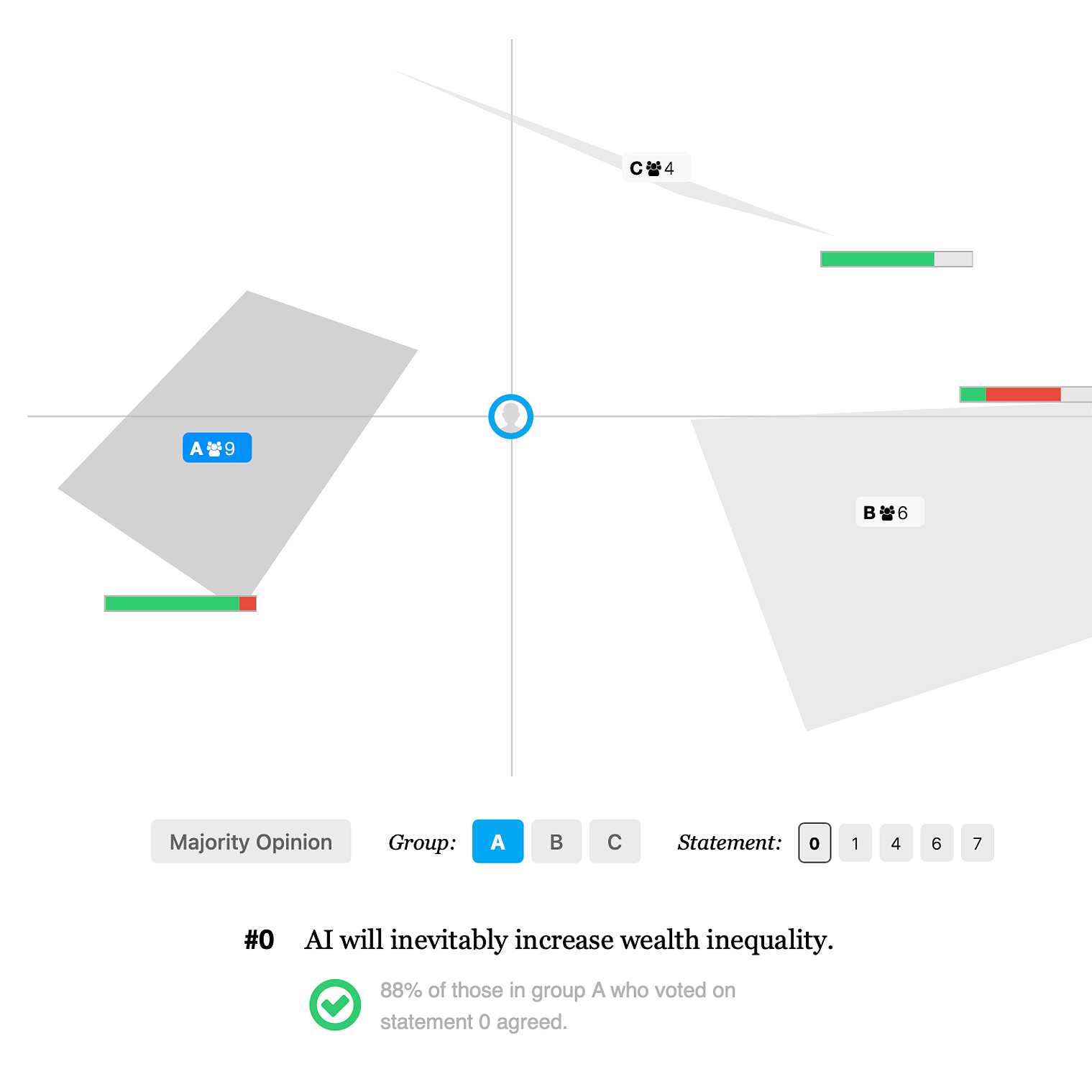
The clustering surfaced three distinct opinion groups from the room. Group A leaned toward seeing AI as a structural threat, Group B toward viewing it as a manageable economic shift, and Group C (the smallest) sat between them. Their spatial separation in the visualisation reflects how differently they answered most statements.
What was more interesting was where they converged. On Statement #4, "Without global cooperation, AI will make inequality between countries worse", 89% of the room agreed, including 100% of Group A, 83% of Group B, and 75% of Group C. A politically mixed audience landed on shared ground on a question usually treated as polarising.
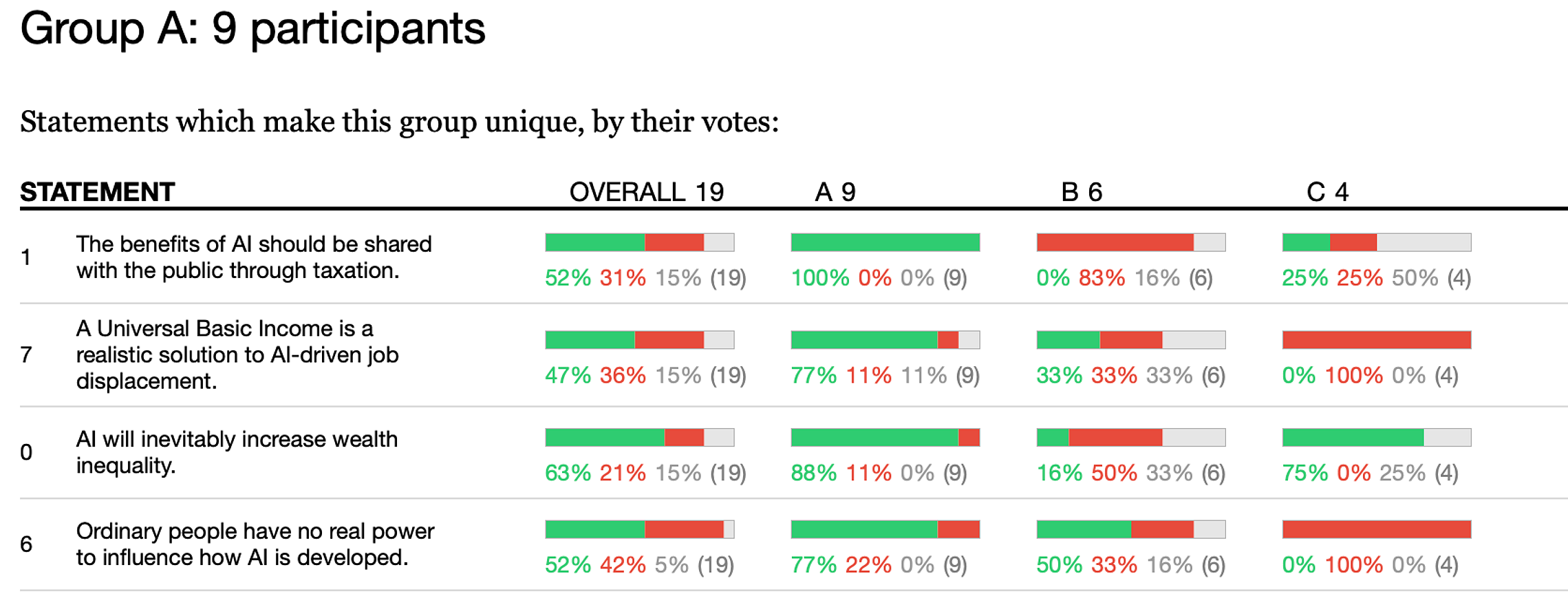
The room disagreed on almost everything, whether UBI is a realistic response to job displacement (Group A: 77% agree; Group C: 100% disagree), whether ordinary people have any real power over how AI develops (Group A: 77% agree; Group C: 100% disagree), even whether AI inequality is inevitable.
But Statement #4, "Without global cooperation, AI will make inequality between countries worse" , drew 89% overall agreement, including 100% of Group A, 83% of Group B, and 75% of Group C. It was the only statement that united the room.
What I Took From It
The students arrived sceptical of AI, sometimes openly resistant. They were there to discuss AI and wealth inequality, after all. So proposing an AI-enabled civic tool to that exact room was a small provocation. Most expected a panel; I asked them to feed live opinions into a clustering algorithm.
What surprised me was that the tool worked because of their scepticism, not in spite of it. The room disagreed on almost everything: whether UBI works, whether ordinary people have any influence, whether AI inequality is even inevitable. But on the question of global cooperation, they were nearly unanimous. A room that didn't want to use AI tools used one to discover where they actually agreed.
That tension is the thing I want to keep designing for: AI tools that earn their place in rooms that didn't ask for them.
The full interactive report, with every statement and group profile, is public: pol.is/report/r5uat5njrapbi2ddpkatb